
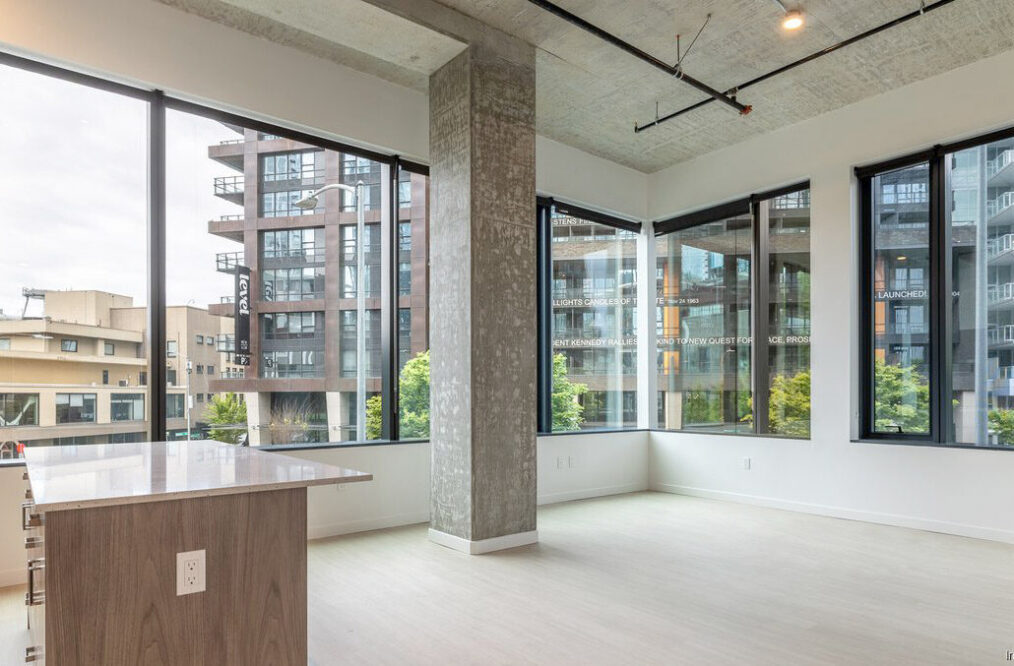
Ivey on Boren has become the first project completed under Seattle’s Office-to-Residential Conversion program. On June 12, developer Holland Partner Group received a certificate of occupancy for the 44 new apartments converted from three floors of vacant office space, joining the building’s existing 406 luxury units.
The city launched the conversion program to address two post-pandemic challenges at once: vacant office space and limited housing supply. Several projects are now in the pipeline. At 2601 Elliott Avenue, the former Zulily and RealNetworks headquarters is being transformed into 260 residential units, including 26 designated as affordable. Exterior elements of the designated historic property will be restored in keeping with its origins as a waterfront cannery.
In Lower Queen Anne, Stream Real Estate is adding a fifth story to a vacant four-story office building at 201 Queen Anne Avenue N to create 74 total units, with residents expected to move in this summer. In Ballard, an earlier-stage conversion at 5621 22nd Avenue NW would turn 23,000 square feet of office space into 23 units.
At Ivey on Boren, the converted floors were originally built for Cornish College of the Arts, which no longer needed the space after the pandemic. Holland spent five years trying to lease the offices before deciding to convert them in June 2025. Construction began that October. Direct construction costs totaled $315,000 per unit.
Office conversions remain challenging despite city support. Projects can be difficult to scope out due to incompatibilities in leasable space, plumbing, heating and ventilation systems, and older buildings often require seismic retrofits or updates to meet current energy codes. Holland’s conversion was more straightforward: the Ivey was a newer building that the firm had constructed itself, leaving little room for surprises during the conversion. The firm leaned into the space’s tall ceilings and exposed pipes and columns, marketing the apartments as desirable loft-style units. So far, about 30% of the units have already been leased.
This post was based on information found on Puget Sound Business Journal and Seattle’s Office of Planning and Community Development (OPCD).
Photo by Brent. R Smith