On Lake Union and Portage Bay, longtime floating home residents are moving on, and young families are taking their place. For many newcomers, the draw is as much the close-knit community as the uniqueness of the homes. Neighbors see each other daily, stopping to chat on shared docks, and that sense of community is part of the appeal. Inside, though, the homes are private and quiet, and docks are usually silent by 9 PM.
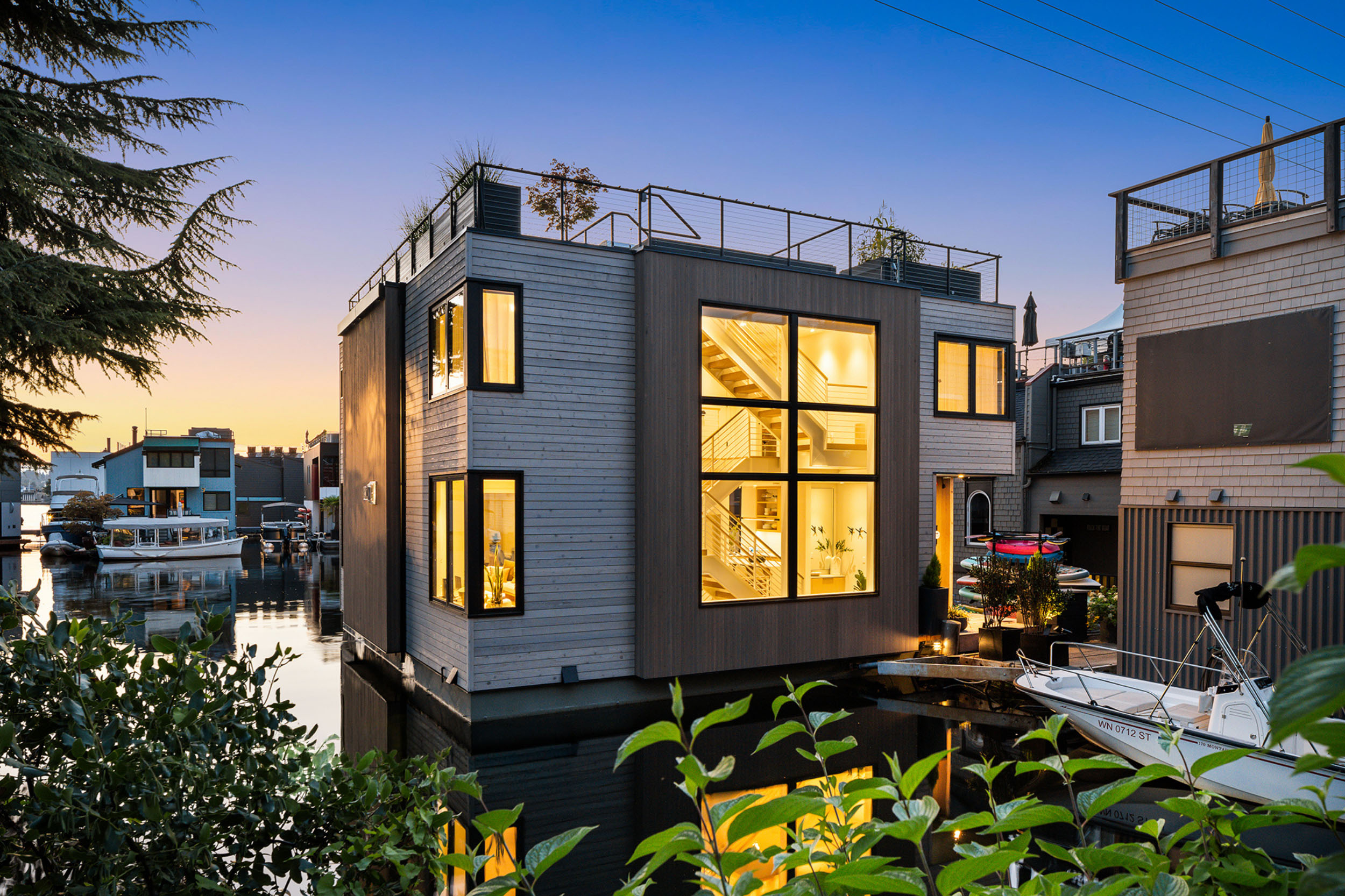
New residents are discovering that the homes need work. Many date to the 1920s and 1930s, and the ones built after 1960 often sit on cement and Styrofoam floats that can become waterlogged over time. Some homeowners are finding a light remodel can turn into a full rebuild once they discover common issues like water damage, missing insulation, or structural problems. The rebuilds tend to lean more modern, with skylights, bigger roof decks, and Scandinavian-inspired interiors, but still carry a touch of the quirkiness Seattle’s floating homes are known for.
The community’s 507 homes are spread across 70 docks in Eastlake, Westlake, Northlake, and Portage Bay. The city restricted each home’s footprint in the 1970s and capped the total number of floating homes at just over 500 in 1987. Current listings range from around $300,000 for a one-room floating cabin to $4 million for an end-slip home with five decks. In 2021, a 3,000-square-foot end-of-dock home sold for $6 million. Ownership is mixed, too. On one dock, eight homes are full-time residences, five are second homes, and four are long-term rentals. Short-term rentals are prohibited.
The community spirit of floating homes runs deep in the history of Seattle. Floating homes started as sleeping quarters for logging crews in the 1880s, and by the 1930s Seattle had more than 2,000 of them. By the early 1960s, as the city pushed back on them, the count had dropped to fewer than 1,000. Residents banded together to form the Floating Homes Association in 1962, then built their own sewer system in 1965. Today the homes are fully connected to city utilities and governed like any other Seattle neighborhood. The association is still active in Eastlake, where it opened a small museum earlier this year.

Longtime residents are encouraging newcomers to bring their own taste and style, welcoming a new chapter for Seattle’s famous floating homes.
This post was based on information found in The Seattle Times.